
How to Use Body Doubling at Home for Adult ADHD Focus Science
You sit down to pay bills, and your brain darts in ten directions. The laundry stares back. Your laptop pings. That familiar ADHD stall hits hard at home, especially in the US and Europe, where millions juggle remote work. You are not lazy. You are not alone.
Body doubling at home offers a simple fix: you work alongside another person, in-person or online, without chatter. CDC data show 15.5 million US adults (6.0%) live with diagnosed ADHD today, and European experts estimate 2–5% prevalence across EU adults. Both regions report underdiagnosis and medication shortages. You need executive dysfunction support that does not rely on pills alone.
Imagine finishing tasks faster because someone else quietly anchors you. Researchers at Drake University tested this and found no harm, with 62% preferring the body-double condition. You can start body doubling today with free tools. Keep reading, and I will show you exactly how.
How to Start Body Doubling at Home for Adult ADHD Focus
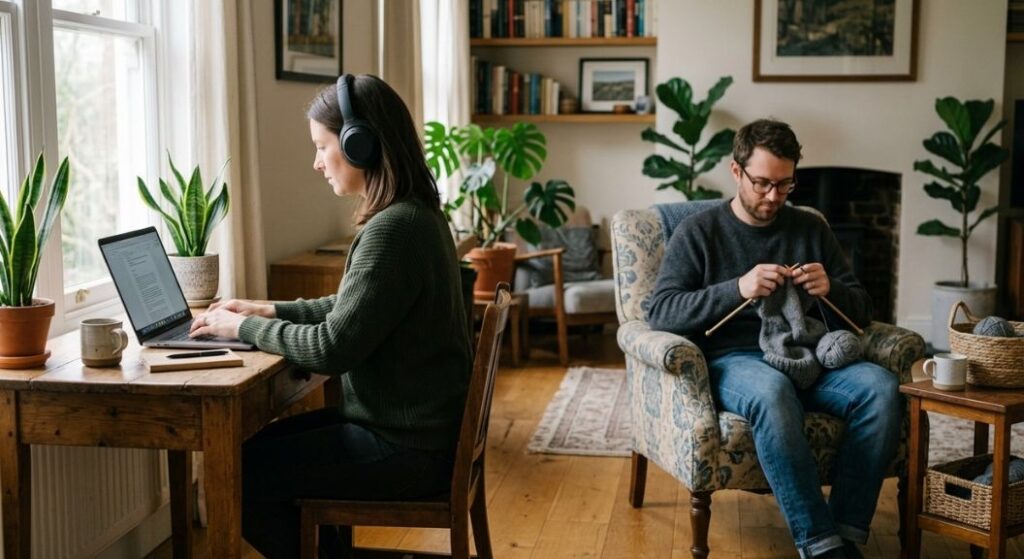
You start by naming one boring task, not five. Pick dishes, email triage, or budget review. Set a timer for 25 minutes. Invite your ADHD accountability partner to sit nearby or join a video call. You both state goals out loud, then work silently. This clear start tackles task initiation strategies that ADHD brains crave.
Your brain responds to social presence, not pressure. You feel watched in a gentle way, which lifts dopamine and motivation just enough to begin. Much like the myths surrounding caffeine hacks we debunked in our Productivity Science deep dive, body doubling thrives on real accountability, not hype. You gain momentum without willpower battles.
What You Need Before Your First Body Doubling at Home Session
You need three things: a clear task, a quiet partner, and a timer. Choose a space with natural light. Keep your phone 3 feet (about 1 meter) away to cut pings. Tell your partner the rule: no advice, just presence. This setup answers how body doubling works at the simplest level.
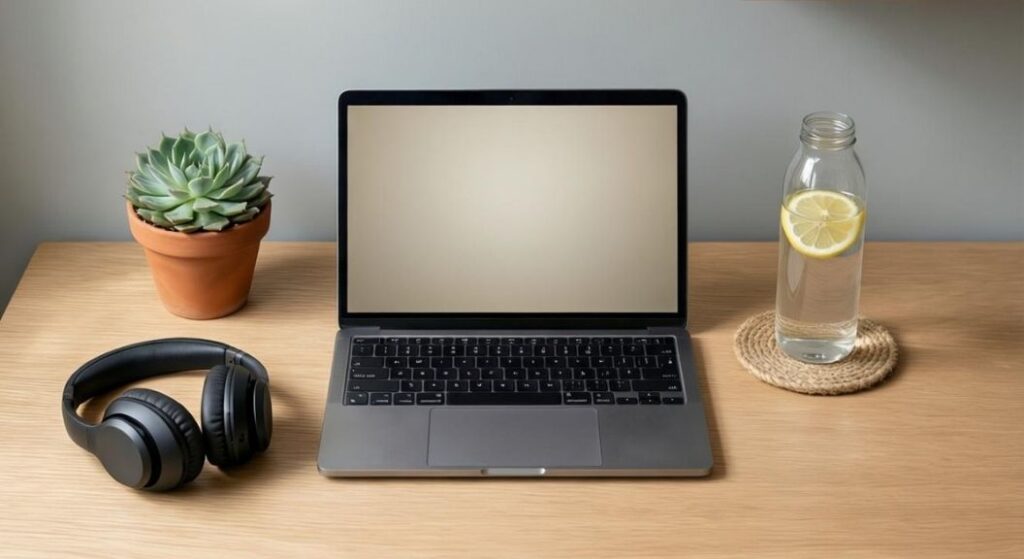
Gather water, headphones, and your to-do list. You reduce friction when everything sits within arm’s reach. If you create an ADHD focus space ahead of time, you avoid mid-session wandering. Europeans often use kitchen tables; Americans favor home offices. Both work when you define boundaries. You signal your brain that this spot means work, not scrolling.

Simple 5-Minute Setup for Body Doubling at Home for Beginners
Set a timer for five minutes. Open your video tool or invite your housemate. Place your laptop at eye level. State your goal: “I will file ten receipts.” Your partner nods and opens their own task. You both hit start together. This ritual builds adult ADHD productivity hacks into a habit.
When the timer dings, you check in for 30 seconds. You share wins, not excuses. Then you reset. You can schedule body doubling sessions twice daily to train consistency. Drake University researchers note participants felt safer with this structure, even without huge performance jumps. You learn what works for your unique brain.
How to Choose the Right Body Double Partner Without Distraction
You want calm, not chatty. Pick someone who respects silence. A spouse can work, but friends often perform better because emotional stakes stay low. You explain the role: sit, work, stay present. This defines your ADHD accountability partner clearly and prevents rescuing or nagging. You protect focus by setting expectations upfront every time.
Test three options: in-person housemate, coworker on Zoom, or a stranger via a co-working app. You notice which setup lifts energy without distraction. Europeans often prefer structured community groups due to GDPR-friendly platforms. Americans lean toward casual peer swaps. You choose what sustains virtual co-working for ADHD comfort and respects your privacy needs.

How to Set Up Your Home Space for Maximum ADHD Focus
You design your space for visual calm. Clear the desk except the laptop, water, and task materials. Face a wall, not a window with traffic. Use warm light at 2700K. Keep noise under 50 decibels. When you create an ADHD focus space, you reduce the executive load that fuels procrastination every single day.
Add a body-double chair 4 feet (1.2 meters) away at a 90-degree angle. You see presence without eye contact. Put a small plant between you for a soft boundary. Europeans often lack spare rooms, so they use a kitchen corner. Americans with basements can zone a nook. You make proximity intentional. You train your brain to associate this spot with the start.
How to Use Virtual Body Doubling at Home When You Live Alone
You live alone, and that is common. You open a free co-working room, mute your mic, and keep the camera on. You find a virtual body double in under two minutes on platforms like Flow Club or Focusmate. You state your task in chat, then work. The silent grid of faces provides the same anchor as a roommate.
You protect your data, especially in Europe. Choose services with clear GDPR consent screens. In the US, check HIPAA-friendly options if you discuss health tasks. You set a 50-minute block, then take a 10-minute walk. This rhythm mirrors Pomodoro and supports staying focused with ADHD at home without overwhelm.

How to Track Progress and Build Consistency with Body Doubling
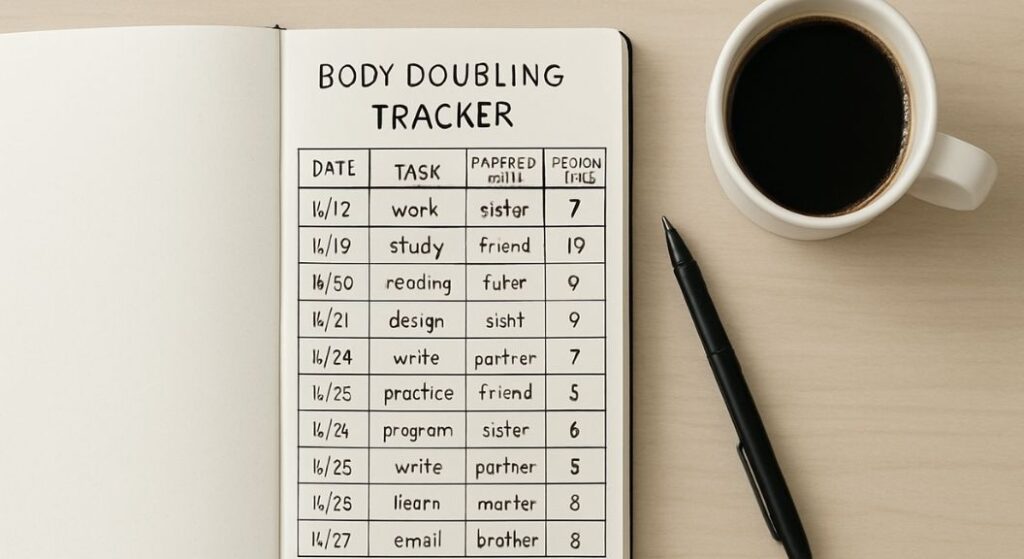
You log each session in a simple sheet: date, task, partner type, focus rating 1–10. After two weeks, you spot patterns. You notice Tuesdays work best with video, Fridays with in-person. This data beats guesswork and builds task initiation strategies you can trust.
You celebrate streaks, not perfection. Aim for three sessions weekly, then scale to five. A global meta-analysis found symptomatic adult ADHD affects 6.76% of adults worldwide, so consistency matters more than intensity. You review logs monthly and adjust. Small wins compound into lasting change.
7 Best Free Tools for Body Doubling at Home in 2026
You do not need pricey apps. Try these free options that US and EU users trust. You try free co-working apps first, then upgrade only if needed.
- Focusmate – 3 free sessions weekly, camera-on accountability
- Flow Club – community rooms with GDPR compliance
- MyNoise – background soundscapes at safe volumes
- Toggl Track – simple timer with visual cues
- Discord ADHD servers – peer body doubling channels
- Zoom personal room – mute, pin partner
- Google Meet + Calendar – schedule body doubling sessions automatically
You test one tool per week. You keep the interface minimal to avoid dopamine traps.

5 Types of Body Doubling That Actually Work for ADHD Adults
You match the type to the task. Parallel work suits the admin. You both do separate spreadsheets quietly. Body doubling for chores works when your partner folds laundry while you clean dishes. You use body doubling for chores to beat avoidance.
Co-working sprints help creative work. Study halls aid reading. Accountability check-ins support ADHD procrastination solutions for big projects. Silent video mimics office presence. Each type leverages social presence differently, so you experiment and note what lifts dopamine and motivation most reliably.
10 Reasons Body Doubling at Home Beats Working Solo with ADHD
You gain external structure without a boss. You reduce start-up friction. You feel less isolated, a key issue in remote Europe and US suburbs. You borrow calm from your partner’s nervous system. You increase task completion. You lower shame spirals. You build a routine. You practice why body doubling helps ADHD in real time. You save money versus coaching. You protect the medication supply during shortages reported by the CDC. You create joy in boring tasks.
These benefits emerge because your brain mirrors steady behavior, a mechanism researchers link to executive function scaffolding, not magic.

6 Common Mistakes to Avoid When You Start Body Doubling
You talk too much during sessions. You pick a critical partner who corrects you. You multitask with social media open. You skip the clear goal. You choose noisy cafes over home. You expect miracles on day one. Each mistake drains the benefits of body doubling.
Fix them fast. You set a no-talking rule. You choose neutral partners. You close tabs. You write a one-sentence goal. You return to your quiet corner. You track progress for 14 days before judging results.
Stop Doing This If Body Doubling at Home Feels Distracting
You stop inviting partners who fidget loudly. You stop using your bed as a desk. You stop leaving your phone face-up. You stop scheduling sessions after 9 p.m. when your arousal dips. You stop expecting your partner to manage you.
Instead, you control the environment first. You place the phone in another room. You dim the lights to 300 lux after sunset. You choose morning slots when dopamine and motivation peak naturally. You reclaim agency, and distraction fades.
Start Using Body Doubling for Boring Chores and Admin Tasks
You hate dishes, bills, and email. You pair each chore with a body double. You use body doubling for chores by calling a friend while you both fold laundry. You set a 15-minute timer. You race the clock, not each other.
You apply the same method to taxes. You sit with a partner on mute while you sort receipts. The European Network Adult ADHD notes that adults often avoid admin due to executive overload. You counter that overload with shared presence, and tasks shrink.
Unlock Deeper Focus: Master Body Doubling at Home Routines
You build a weekly rhythm. Monday and Thursday, virtual co-working for deep work. Wednesday, in-person for chores. Friday, solo review. You protect these blocks like medical appointments. This routine answers how body doubling works long-term: repetition wires the habit.
You layer cues: same playlist, same mug, same chair position. Your brain learns that these signals mean start. After four weeks, you notice less resistance. You have transformed a hack into a lifestyle that supports adult ADHD productivity hacks without burnout.

Transform Procrastination into Momentum with Daily Body Doubling
You treat procrastination as a signal, not a flaw. When you stall, you text your partner: “10-minute start?” You launch immediately. This micro-commitment bypasses the amygdala alarm that stalls ADHD brains. You create forward motion daily.
You track momentum, not hours. Did you start? Yes or no. Over a month, your start rate climbs from 30% to 70%. The PMC prevalence study reminds us that adult ADHD persists for millions, so you design systems, not shame. Daily body doubling becomes your launch pad.
Why Does Body Doubling at Home Work for the ADHD Brain?
You lack internal brakes, not intelligence. Barkley’s model, cited by Drake researchers, frames ADHD as an inhibition deficit. External presence acts like scaffolding. You borrow the other person’s calm tempo. Your mirror system picks up their steady pace, and you follow.
Data shows mixed but promising signals. The EEG study found no negative effects and trends toward fewer distractions for unmedicated adults. Europeans face underdiagnosis, Americans face prescription gaps. Body doubling fills that gap safely. It does not replace medicine, but it adds structure you control.
Fact Box: Adult ADHD by the Numbers
| Region | Estimated Prevalence | Key Data Point | Source Context |
|---|---|---|---|
| United States | 6.0% (15.5 million adults) | Half diagnosed in adulthood; 71.5% report stimulant shortages | CDC MMWR 2023 |
| Europe | 2–5% | Widely underdiagnosed and undertreated across the EU | European Network Adult ADHD Consensus |
| Global | 2.58% persistent; 6.76% symptomatic | 139M–366M adults affected in 2020 | Global meta-analysis |
Fact-Minded Verdict: Mixed – Early studies show safety and user preference, but large-scale trials are still lacking.
FAQs:
1. What is body doubling for ADHD?
It’s working alongside another person — in person or on video — who stays quietly present while you do your task. Their calm presence acts like gentle accountability for your brain.
2. How does body doubling at home actually work?
You pick one task, set a 25-minute timer, and have your partner work silently nearby. Your ADHD brain mirrors their steady focus, which boosts dopamine just enough to start and stay.
3. Does body doubling really help adults with ADHD?
Early studies show it’s safe and 6 in 10 people prefer it, with promising trends for fewer distractions in unmedicated adults. It’s not a cure, but it’s a low-risk tool that many find effective.
4. Can I do body doubling if I live alone?
Yes. You can find a virtual body double on free apps like Focusmate, Flow Club, or even a YouTube “study with me” video. The live or recorded presence gives you the same anchor.
5. How do I start body doubling at home today?
Choose a boring chore, text a calm friend, or join a free co-working room, state your goal out loud, then work silently together for 15 minutes. That’s it — no special setup needed.